Sound Bar Quick Guide
Installing and using the Product
- a Connect the soundbar to your TV via an optical cable or an HDMI cable.
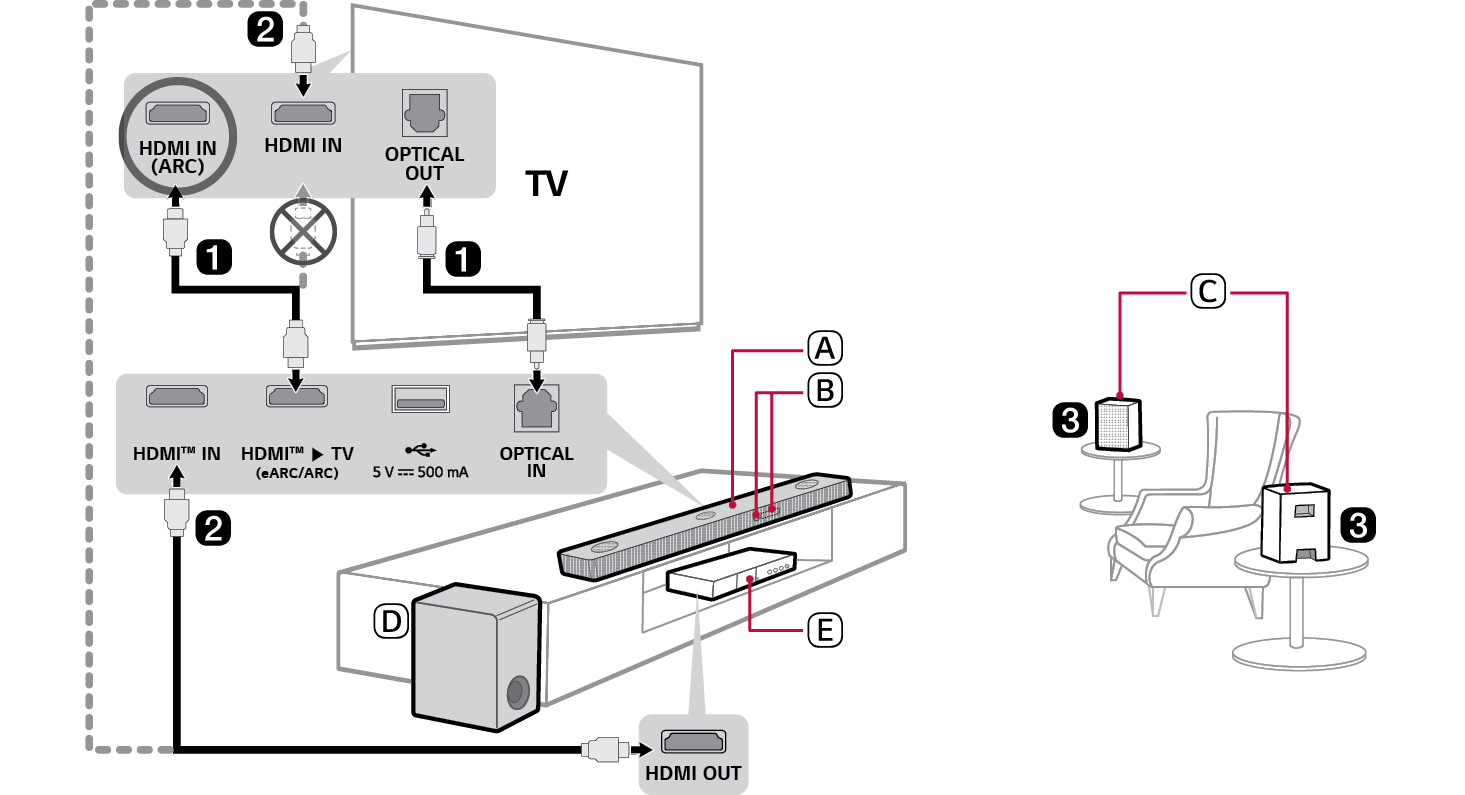

- A Soundbar
- B Remote Control Receiver / Status Display
- C Wireless Rear Speakers
- D Wireless Subwoofer - Install it close to the soundbar.
- E External Device - (Blu-ray player, game console, etc.)
- b If you are using an external device (ex. Set-top box, Blu-ray player, game console, etc.), connect it to the soundbar or to the TV via an HDMI cable.
- c Connect to power in the following order: wireless subwoofer [ wireless rear speakers [ soundbar. Then, turn on the soundbar. When the connection is automatically established with the soundbar, the LEDs on the wireless subwoofer and wireless rear speakers will light up green. ([ See “Connecting the Product” on page 6.)
- d Using the product with your TV ([ See “Connecting with an Optical Cable”, “Connecting with an HDMI Cable”, “Connecting via Bluetooth” on page 31, 33, 35.)
-
A Press the Function
 button repeatedly until “OPT/HDMI ARC” appears on the status display.
 - B On your TV's settings, set the output speaker to [HDMI ARC], [Optical], or [External Speaker].
- C When the TV is properly connected to the product, “OPT”, “ARC”, or “E-ARC” will appear on the status display with a sound.
- e Connecting the product to your smartphone via Wi-Fi ([ See “Connecting with a Smartphone via Wi-Fi” on page 16.)
- A Connect your smartphone to Wi-Fi.
- B Install the LG Soundbar app on Google Play or the App Store.
- C Run the LG Soundbar app and follow the instructions.
- D The product will connect to your smartphone and you can control the product with LG Soundbar app.
- f Connecting the product to your smartphone via Bluetooth ([ See “Connecting via Bluetooth” on page 40.)
-
A Tap the Settings
 button on your smartphone and select Bluetooth. Turn on the Bluetooth function. (
 Off >
Off >  On)
On) -
B Press the Bluetooth pair
 button. After a moment, you will see “BT READY” on the status display.
 - C Find and select “LG_Speaker_DS80TR_XXXX”.
- D When the product is connected to your smartphone via Bluetooth, you can see the status display change from “PAIRED” [ “Connected Bluetooth device name” [ “BT”.
Manually connecting the soundbar to the wireless subwoofer or wireless rear speakers ([ See “Connecting the wireless subwoofer and wireless rear speakers manually” on page 8.)
If you see a red LED on the wireless subwoofer or wireless rear speakers, it means that the soundbar is not connected to the speakers. If this is the case, connect them in the following order.
-
A Press the Power
 button on the soundbar to turn it off.
 - B Press the PAIRING button on the back of the wireless subwoofer or wireless rear speakers. Check if each LED blinks green.
- If you still see a red LED on the wireless subwoofer or wireless rear speakers, press and hold the button on the back of the subwoofer or wireless rear speakers again.
-
C Press the Power
 button on the soundbar to turn it on.
 - D When the connection is established, you will see a green LED light on the wireless subwoofer or wireless rear speakers light up green.
Table of Contents
Soundbar Quick Guide
2 Installing and using the Product
Installation
6 Connecting the Product
10 Setting up surround sound
16 Connecting with a Smartphone via Wi-Fi
20 Resetting the Product
Exploring the Product
21 Front
23 Back
24 Exploring Remote Control
Various settings for convenience
28 Convenient functions
Connecting to the TV
31 Connecting with an Optical Cable
33 Connecting with an HDMI Cable
35 Connecting via Bluetooth
Connecting to an External Device
36 Connecting with an HDMI Cable
39 Connecting with an Optical Cable
Using the Product as an Audio System
40 Connecting via Bluetooth
43 Connecting to a USB Storage Device
45 Using the LG Soundbar app
46 Compatible with Google Assistant
47 Works with Apple AirPlay
48 Spotify Connect
49 Works with Alexa
50 Tidal Connect
Mounting the Product to a Wall
51 Checking before mounting to a wall
53 Mounting the Product to a Wall
Safety Precautions
55 Safety and Regulatory
58 Prevention of product misuse
Before Reporting Product Malfunction
62 Troubleshooting
Appendix
68 Specifications
70 Registered Trademarks and Licenses
72 What You Need to Know about Network Services
72 Open Source Software Notice Information
73 Handling the Product
Installation